Bonnie Ho Gabaeff

About Bonnie Ho Gabaeff

Rev. Bonnie Ho Gabaeff is a calm, reflective presence for deep seekers — holding sacred space for spiritually curious, sensitive souls to reconnect with their inner voice. As the founder of The Journey Circle, she guides others through Tarot, journaling, and intuitive mentorship toward deeper self-awareness and trust. Bonnie’s approach blends depth and practicality — rooted in her years as a researcher in tech and video games, and spiritual backbone through her training in San Francisco’s Psychic Horizon — a School of Clairvoyance, healing and meditation, she was ordained through PH’s Church of Natural Grace in 2018. Whether you’re learning Tarot, deepening your connection to self or an old soul exploring your timeline, Bonnie’s work is here to offer you grounding, insight, and soul-affirming perspective. Born in Hong Kong, and raised outside Philadelphia, Bonnie now lives in Sonoma County, California where she enjoys cooking, hiking and playing competitive Tetris.

Giving myself permission to not be on Instagram

Giving myself permission to not be on Instagram

A small act of rebellion that felt surprisingly sacred. Learning to trust my own rhythm instead of the algorithm’s.

Confession time. It’s been 242 days since my last post on Instagram.

The last one was on Halloween, where I talked about not being a “holiday person” and giving myself permission not to force a message just because it was a holiday.

It reminded me of to those ye olde days when I was an e-commerce marketer. We used the excuse of a holiday to put out a message. We’d offer a coupon to tempt people to buy and used long weekends as a sense of urgency to get customers to act.

My job was to increase metrics with these tactics—click-through rates, conversions, to monetize. That was my career. Those were the goals I strived towards for a long time.

As one who now offers spiritual services, I feel a sense of rebellion against those yang-heavy strategies.

But still, I can’t help but pressure myself to do more marketing, with Instagram being my drug of choice to fixate on.

I have been pressuring myself to post on Instagram for the last few years. Sometimes I would go days, then weeks without posting, and there was this internal pressure, guilt that I should be doing more.

After that Halloween post, something got triggered within me, a whiny inner child who really just didn’t wanna; I had very little inspiration to post on Instagram.

And yet, that overly-responsible, inner e-commerce marketer trained in the finest best practices whispered bitter-nothings in my ear:

Don’t you know it’s a best practice to post regularly?

What about the algorithm?!

You have to keep posting to keep people, and the algorithm interested.

It was like I knew too much, and was pressured by that knowledge. The pressure to post made me not want to post. And not posting created even more pressure.

So I decided:

I’m giving myself permission not to post on Instagram.

With that permission, the e-commerce marketer within me quieted down a bit.

But then a new shadow character emerged: The Virgo North Node Stellium “Good Girl for god”.

She’s the one who wants to do right. Service-oriented, always wanting to help, sacrificing at the expense of herself.

Ms. “Good Girl for god” whispered guiltingly:

But if you’re not posting and putting out merry messages, then you’re not doing your service work.

If you’re not posting, you’re not doing the Divine’s work.

The pressure returned.

Pressure. Pressure. Pressure.

As I contemplated this pressure, I examined Ms. “Good Girl for god’s” proclamations, and considered what this ‘god’ (Or the Divine. Or the Universe.) may be like.

I imagined standing at the pearly gates. (Not actually what I believe.)

And God saying:

“You will not enter Heaven because you didn’t post enough on Instagram.”

Wow. Uproarious LOL ensued.

The thought made me laugh so hard because it’s a completely ridiculous notion.

The God—or Divine—that I know would never say that. The idea that I’m somehow off my path and not being enough of a ‘good girl’ because I haven’t posted enough on Instagram is absurd.

The idea that God would judge me for not following a content calendar is laughable.

But obviously the fear was within me, and clearly there was part of me that believed in this ‘god.’

I wondered: Who is this “god,” exactly? Who is actually talking?

…

And then, it hit me. It’s the “god” who taught me everything I know about online marketing best practices. The one who reprimands me when my metrics aren’t growing. The one who enslaves me to likes, clicks, CPMs, AOVs, and endless optimization.

Because if I don’t…

I won’t get the bonus.

I won’t get the promotion.

In other words, I won’t get into ‘heaven’.

It’s the “god” I served for over twenty years in Tech.

During that time, every morning, I got my morning coffee, and I would sit down at my desk and open ten browsers where I would pour over reports, numbers, campaigns. Or in my later career, I would look through excel spreadsheets of research data.

It was that god.

The patriarchal god that duped me into believing all of that was more important than anything else. More important than my own well-being. More important than caring for the people we serve.

It was a way of living I developed when I thought that monetary success, metrics, and pure ambition for validation was what was important. But in reality, it pulled me away from what truly matters.

And for me, what matters is the message itself. Something I want to get out there that is supportive and shifts perspective and healing. Stories that helps people feel less alone in the world.

And expressing it in a way that is true to me — deep nuance that creates empathy, a resonance that arises from my heart. Even if not everyone may understand what I’m saying; those who do — do. And those are the people I’m talking to.

From an energy standpoint, I’ve realized that it can takes a long time for me to craft a message. I am slow. I like to be deliberate.

Sometimes a message takes gestation. It mulls within me for days, weeks, months and even years, before its ready to be written to digital paper.

It is the yin way that works for me. Being with the cycles of my own rhythms.

I’m also wordy. That 2,200-character limit on Instagram just doesn’t work for me.

I need room. Space. I need whatever wants to flow through me to do so in its own time. In its own way.

The god / Divine I believe in doesn’t care if I post on Instagram.

The god / Divine I believe in, simply wants me to be me.

That is all I need to do to be of service.

Whether I’m being myself on Instagram, on Substack, with a friend, while teaching a class, or grocery shopping at Trader Joe’s, I don’t think the Divine pays much attention to where it happens.

The Divine simply wants us to express ourselves—and our love—in whatever way feels true for us.

And one day, after I’ve fully given myself permission not to be on Instagram…

Maybe I’ll go back.

Maybe one day I’ll feel inspired to write short-form posts and share pretty pictures again. (There was a time when I genuinely enjoyed it.) But if, and when I do: I’ll do it my way, in my own rhythm.

It’s not the technology itself, it’s how we choose to use it.

We may feel that we have to feed it for our own survival, but it’s up to us whether we give in to that feeling.

Tech has brought beautiful things into my life. I wouldn’t get to be writing this to you, and you reading it, if not for Tech.

I don’t regret my career. It’s a journey that’s brought me here. It taught me skills I still use, lessons that brought me wisdom. And honestly, I still enjoy analyzing data and seeing the insights that speaks through it.

Just because there were good things doesn’t mean I have to embrace the values that no longer resonate with me. Or perhaps some values are okay, but it’s about coming to a balance with it.

I’d like to believe that at the root of Tech, it is attempting to make lives easier, more efficient, more connective. (Or at least that’s what they say at every funding pitch ever!) That is to say… Whether the intention is real is questionable. And different for every person who works in Tech.

But we can make that intention real for ourselves.

We can ask ourselves how technology can serve us—not how we can serve it out of fear, obligation, or what we think we “should” do.

It’s about coming back into balance within ourselves. A way that feels healthy. Loving. Resonant.

I hope we can.

I hope I can.

May it be so.

2026-09-10T17:32:20+00:00

The Divine Feminist: Re-Defining Strength, a different type of courage

The Divine Feminist: Re-Defining Strength, a different type of courage

I became an empowered woman. Then I realized the journey didn’t end there.

2026-09-10T17:17:27+00:00

The Pull Toward Alignment: An irresponsible leap and how the Universe caught me

The Pull Toward Alignment: An irresponsible leap and how the Universe caught me

“Leap. You go first. The Universe will catch you.” -Rebecca Campbell. My Moving to San Francisco Story. On trusting my gut with an irresponsible leap — only for the Universe to catch me.

2026-09-10T17:05:15+00:00

Women want respect. How owning my feminine power changed my life.

Women want respect. How owning my feminine power changed my life.

Respect is a baseline, not a request. What began as one offhand comment about feminine power slowly changed my entire life.

I hear it all the time: women want respect. They want respect from their jobs, their co-workers, their romantic partners and spouses. They want respect from family, parents, and friends.

I wanted respect too.

For a long time, I filled pages of my journal writing about how my colleagues didn’t respect me. I was a woman in a male-dominated field, and more than anything, I wanted to be seen and valued.

And when I think of disrespectful colleagues, one guy immediately comes to mind.

He was snarky. A know-it-all. Self-righteous. You know the type. He interrupted me when I spoke and dismissed my ideas. He was the worst.

The breaking point came when an executive tried to pull a power move by reorganizing me onto this know-it-all’s team and making him my manager, and he did it by sending out an email to the company without consulting with me first. In the very same email, the executive also tried to take credit for my work.

I was livid at him and this executive for disrespecting me in this way. I went to my manager and told him that if this is happening, I was quitting effective immediately.

My manager understood how I felt and shut the whole thing down. He told me that it was an idea that had been floated around, but was never actually approved. My reaction also made him realize just how much tension there was between me and this colleague, so he started running interference and made it so we didn’t have to work together as closely.

But still, even his mere presence grated on me.

In sessions with my spiritual counselor, I would complain endlessly about him. My counselor was usually patient, but this time she could no longer remain completely impartial.

Finally, she blurted out, “Bonnie, you’re letting this guy take away your feminine power.”

I didn’t know it at the time, but her slightly off-the-cuff comment planted a seed.

It stopped me in my tracks. Feminine power? Hmm… what does that even mean?

I was curious, and honestly, slightly triggered. Is she saying I’m not feminine enough? But my counselor didn’t elaborate much beyond that. She simply suggested I explore the question for myself.

—

She was right.

After a lot of healing and exploration, I can now look back and see it clearly: I was giving my power away to this guy. More specifically, I was giving away my feminine power.

And when I say “feminine,” I don’t mean feminine in the stereotypical gendered sense — lipstick, dresses, or jewelry. This terminology was what triggered me; I assumed that she wanted me to appear more ‘feminine’, that was not what she meant at all.

She had meant the yin-feminine — the other half of the concept of yin and yang. Two opposing energies that are within all of us (regardless of gender) that contribute to our wholeness. I had a well-developed yang, but my yin-feminine — I had long abandoned.

And to be clear. Nor do I mean female empowerment in the “kick ass and take names” sense either. In many ways, that was actually the yang energy I was already trying to embody at the time. I was pushing back constantly, doing everything I could to fight the disrespect I was experiencing.

When I say, my feminine power, I mean, the yin: a deep, innate knowing, a connection to myself — that I can trust in myself. A heart-felt knowing of my worth.

When I say, my feminine power, I mean: I yield to my inner serenity, a stillness within; and to tend to my own sanity.

Women want respect; crave respect — and yet, so often, we disrespect ourselves by giving our power away in the pursuit of it.

When we trust in our worth, we no longer disrespect ourselves by working way harder than our male counterparts to prove we deserve respect.

When we nurture our serenity, we no longer give our power away by obsessing over other’s comments or judgements.

When we deeply know what we’re capable of, we no longer disrespect ourselves by over-explaining.

When we give ourselves permission to soften into our inner peace, we no longer give our power away to perfectionism.

For so long, I wanted respect. But what I’ve realized on this journey is that if I want respect, I first have to give it to myself.

Giving myself respect means knowing I am good at what I do, without needing to prove it.

Giving myself respect means going home at a reasonable hour because rest and rejuvenation are necessary for my well-being.

Giving myself respect means knowing that other people’s judgements say more about themselves than it does about me.

Giving myself respect means not giving so much mind-space to someone who doesn’t deserve it.

Let me be clear. It doesn’t mean we shouldn’t push back if we’re being disrespected, we most definitely should. Setting boundaries is our loving yang-side taking action in honor of our self-respect. But along with that, is a sustainable approach that comes from a deeper place.

As women, we often chase respect. And of course we do.

Many of us were taught that respect had to be earned through achievement, performance, or overextending ourselves for others. In the beginning of our careers, we need to demonstrate what we’re capable of, and that striving can help us learn and discover our strengths.

But eventually, there comes a point where constantly proving ourselves stops being empowering, and starts becoming exhausting.

And what’s interesting is that it’s when we stop chasing it — and begin respecting ourselves through a deep knowing of our worth, which translates into actions, boundaries, and intentions — we begin to receive it without asking for it. Because first and foremost, we are giving ourselves the respect we deserve, and that energy radiates from a deep place within us.

This realization completely changed my relationship in work, my love life, and people in general.

Because here’s the thing: I know my worth, and I respect myself. So if someone wants to work with me while being disrespectful? That’s a no.

There are plenty of respectful people out there (men included) — people who truly see you. People who recognize how incredible you are, and who genuinely value your skills and talents.

Those are your people.

Disrespectful people are, of course, still out there. I see them in the media. I see them running our country.

But in my immediate surroundings, I have decided that I am going to put self-respect first and foremost, and I stay in integrity with that self-respect through a connection with my deepest self that translates into actions of self-trust and serenity.

And strangely enough, that shift has acted like an energetic repellent for disrespectful people.

Because when you truly believe respect is inherent. That it shouldn’t even need to be requested, but a baseline requirement — Your life begins to change.

Respect stops becoming something you beg for, earn, or negotiate.

It simply is.

And that, to me, is how we take back our feminine power.

May it be so.

2026-09-10T16:31:20+00:00

The day the US broke my heart

The day the US broke my heart

If you’re feeling sad, feel it.

If you’re feeling confused, feel it.

If you’re feeling angry, feel it.

If you’re feeling dismayed, feel it.

If you’re feeling fear… I am sorry.

I myself am feeling heartbroken. 

In that heartbreak lies all of the sadness, confusion, anger, dismay because I know that many are afraid. Afraid of what will happen. Afraid of what more will be taken from us. 

My heartbreak goes out to everyone in those red and purple places where they stood by what they think is right, and yet, tyranny wins.

My heartbreak shows me that I don’t actually know anything about anything. That there is a lot I don’t understand about the people in this country — their hurt, pain and suffering. And that humbles me to my core. 

My heartbreak shows me my privilege. I am educated. I live in California. And even though I feel the financial pressures, I have more access to resources. And I don’t know what it’s like to feel what they feel. And that humbles me, once again.

My heart breaks open to all of this. As painful as it is, there is also a fire that feels good — a divine grace that seeps in as the fire burns my heart open.

That fire is anger, a sacred anger that is strength and passion. It’s courageous and ready for what’s to come.

We don’t know what’s to come. And let it be an “I don’t know.”

Stay present, my friends. 

Do not let the pictures of what may happen become a prison of your own suffering.

Trust yourself. Trust those who know what to do. Trust in the good. Trust in the love that exists.

Sit with your trust, and your love. And we wait.


Sending much love, Bonnie
???✨

2024-11-08T18:23:37+00:00

Seeing home with new eyes: a Hong Kong homecoming

Seeing home with new eyes: a Hong Kong homecoming

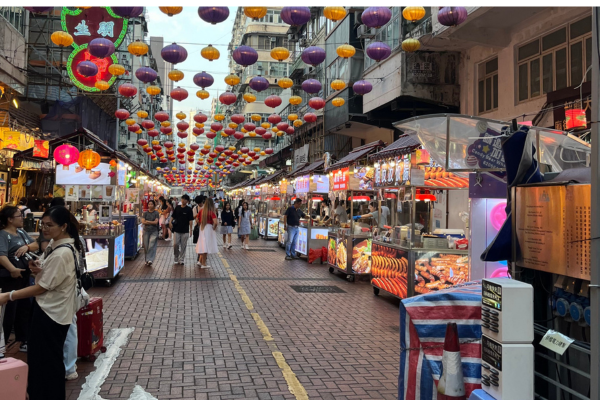
“I’m here to visit my mom,” I repeated nervously in Cantonese to myself, as we queued for customs immigration at the Hong Kong Airport. My Cantonese is hazy, and in anticipation of the customs officer’s question asking our purpose for our visit, I was practicing in preparation.

It’s been 14 years since I’ve been home to my place of birth. Last time I was in Hong Kong, I had just turned 30. Just coming out of my Saturn Return, I was recovering from a hard break-up and was laid off a month earlier from my job. Heart-broken and jobless, my mom beckoned me home to Hong Kong, and I had little fortitude to say no. If I were honest with myself, I also wanted my mommy to take care of me in my vulnerable state. 

Now, things are different and I’m different. Since then, I’ve begun new relationships and jobs, quit relationships and jobs, undergone deep spiritual healing work, started a new career, married my ex-coworker. At 44 years old, I’m going home with my husband to show him where I come from. And to visit my mom.

And yet, old habits die hard. As I practiced my line in Cantonese, it bugged me that I could hear a slight American accent. I am from Hong Kong, and so I know what Cantonese is supposed to sound like, and what I heard in my head wasn’t it. “The tone is not right, my mom is going to give me so much shit for this”, I thought.

As many Chinese American daughters do, I too have a complicated relationship with my mother, as exemplified in old and new classic Chinese American films such as the Joy Luck Club and Everything, Everywhere all at Once. Those mother-daughter dynamics are real, and I’m a living example. I hadn’t even gotten to my mom yet, and she was already criticizing me, in my head. It dawned on me that the ‘mom’ (inside my head) was right in her critique: my Cantonese is bad, and I should just own it. There was something about admitting it that made it feel more okay and empowering. I’m the one who chose not to keep up with it, and so how can I possibly speak it well?

When it was our turn at the immigration kiosk, I felt ready for my big line. I anxiously presented the official our passports. She briefly paged through it and then waved us through without saying a word. Speaking dodged. My inner introvert rejoiced, but it also felt a bit anticlimactic with all that nervous anticipation dashed. There was nothing to worry about after all.

Hong Kong, Hong Kong

As we made our way through the airport to catch the train to Hong Kong Station where we were meeting my mom, clues of the Hong Kong I knew began to emerge. The people, the language, the loud giant screens screaming in our faces. We weren’t in Kansas anymore. Not that we live in Kansas, but Sonoma County California where we live was close enough; there are no giant screens there either, only grape farms.

As we were waiting for our train, a woman asked us in English, “Is this the train into the city?” I told her “yes, it is,” and my ego beamed a bit by knowing something. Even though it’s been 14 years, I was starting to feel like a local again.

As we rode into the city, our first glimpses of Hong Kong appeared in the window. “It’s so green,” my husband commented on the mountainous trees we passed through, “How pretty, I didn’t expect it to be nature-y in Hong Kong.”

It kinda surprised me too. Like I knew that there were pretty nature-like parts of Hong Kong; my parent’s flat faces a mountain with trees, and Hong Kong is an island surrounded by water, and it’s got a lot of Feng Shui and all that, amongst skyscrapers, high rises and brightly lit signage. But back when I was a kid, or even the last time I was in Hong Kong at 30 years old, I couldn’t see it. I couldn’t see the forest or the trees; I couldn’t see the beauty.

The young me (who returned to Hong Kong nearly every year of my childhood since we immigrated to the States as a six year old) saw Hong Kong as hot, humid, stinky, loud, crowded and rude. All I can remember was the unbearable wet heat as I stepped off the plane and into a pile of sweat. All I remember are the mosquito bites that would swell up on my legs and no amount of mopiko would satiate its itch. I remember getting lice at 13, and the shame I felt when my mom made me go get a haircut at the salon and pretend that I didn’t know. (They obviously knew after getting into my hair, and my mom made a huge scene in ‘disbelief’ that I had lice.)

My insufferable memories of Hong Kong was not only physical, it was emotional as well. My aunts would tease us upon our return, “do you still know how to use chopsticks?” and would ask the waiter for a fork just to really stick it to us. There were judgey looks at our American fashions that were always too short, since everyone else didn’t mind wearing pants in 95 degree heat. Even though I was born in Hong Kong, to them — I was American, and I don’t belong.

Let’s face it, Hong Kong people are not particularly nice. The characteristics of Hong Kongers are no-nonsense and straight-forward, and they’re proud of it. They’re there to get things done and they have places to go, so walk fast, or get out of their way. As a shy, sensitive little girl, Hong Kong was challenging and I felt like it was going to eat me up and spit me out if I didn’t keep to myself by making myself silent and small.

But I’ve come a long way and I’m not a little girl anymore — still sensitive, though more empowered. I’ve worked on embracing my Chinese American-ness, social anxieties, and sense of belonging by accepting myself. More so, at least; clearly there’s more to do. At the very least, I am more willing to put aside all of the villainizing stories I’ve built up about my relationship to Hong Kong and admit that my husband’s assessment is correct — Hong Kong is beautiful; I just never noticed before.

As I looked out the window, a familiarity came flooding in. Memories in the deep recess of my brain all of a sudden became my present, though these memories, I didn’t demonize. Instead, it felt more like an old friend I hadn’t seen in a while, and now we’re picking up where we left off.

The woman who married a gwailo

After meeting my mom and a little rest at her flat, I couldn’t wait to go for our first dim sum lunch of many. Food was one thing I do have fond memories of, and I couldn’t wait to share all the yumminess with my husband.

Generally Hong Kong is a very western city given it was a British colony with a decent amount of folks from all over the world. But Heng Fa Chuen where my mom lives is a residential community with a ‘suburb” feel (If you can call a place with dozens of 30 floor highrise apartments ‘suburban’) — not many tourists or expats venture to Heng Fa Chuen; there’s not much there of interest.

My mom took us to a restaurant in the shopping center that is only a 7 minute walk away. Once again, that familiar path came rushing back, but the convenience store where I would go to get mango ice cream was replaced by a ballet studio for kids, and other child genius enhancing establishments surrounding it. It was mostly the same, but it wasn’t at the same time.

When we walked into the restaurant my mom asked the hostess for a table of 3. Without looking up, she pointed at the kiosk. “Get a ticket” she said, with that signature no-nonsense Hong Kong attitude. My mom is fumbly with technology, and even though it was in Chinese, I got us a ticket and handed it over to the hostess. She scribbled something on the paper, which she gave to us without looking at us, “go in.”

It was 11 AM, but it was already packed. We looked for our table and it being my first in-the-wild Hong Kong experience with my white husband, I felt slightly unassured; of course he was the only westerner. There were a few looks over at us, but they weren’t staring or anything. It wasn’t until the subsequent days when I began to notice what they would really glare at: Me.

The next day we were walking to the subway station, and a woman walking toward us saw my husband and she began staring at me. Even as she walked past me, she looked me up and down blatantly, as if to check me out — who would marry a gwailo?

Even as she rudely glared at me, a curious feeling arose: indifference. I love my husband and I love my life. They can judge me all they want, and I still wouldn’t trade it for anything else. That shy, sensitive little girl who tried not to attract too much attention, finally didn’t give a shit. 

In fact, I found on this trip home, there was a lot I didn’t give a shit about. I didn’t give a shit that the hostess was kinda rude by American standards — we believe in service with a smile, but they don’t do that in Hong Kong. That’s okay — you do you Hong Kong.

I didn’t give a shit that I wore shorts because it was hot as hell, and I didn’t care that they could tell I’m American by showing a bit of skin. And I didn’t give a shit that my Cantonese was not that good and therefore slightly aloof when people talked to me, and was proud that I still tried instead of hiding silently or defaulting to English. (And honestly, I picked it up quickly after being immersed, and had only a little accent!).

Just as I have embraced being Chinese in America, I now embrace being American in China. When I was young, I felt othered and ashamed. Now that I’ve leaned into who I am, they can judge me all they want but I don’t feel ashamed of who I am, so I’m fine with it — they can judge as they please.

You can take the girl out of Hong Kong…

At the end of our trip, we were going through security at the Hong Kong airport, and the security officer was one of those power trippy guys you come across at the airport security line sometimes. In English, he was shouting orders. “One at a time, laptop out.” I rushed to get a bin to start the security line routine, and he shouted at me, “Wait! One at a time.” 

As a little girl, I would have been frightened of his authority, but now as a full-fledged adult with a keen sense for behaviors associated with the human condition,  I rolled my eyes at his obvious display of attempted power-play. Sensing my attitude, he looked directly at me and asked me in Cantonese, “Do you speak Cantonese?”  I responded “Yes” in Cantonese. And he sternly but calmly asked me in my native tongue, “Laptop out, do you have a phone?” I said “Yes,” and I went to take it out. And then, he said “Leave the phone in your bag.”

Obvious power move. I did what he said, but if I wasn’t rolling my eyes while I was doing it, I was energetically rolling my eyes the whole time.

After going through security, I reflected on what happened, and I couldn’t help but laugh. I felt like he could tell I was a Hong Kong person; only Hong Kong people would give attitude like that. I may have lived the last 38 years in America. I eat apple pie and hamburgers, and turkey on Thanksgiving. But deep down, when push comes to shove, I am a Hong Konger. No nonsense and I’m proud of it.

⁠
In gratitude, Bonnie
???✨

2024-10-21T18:36:27+00:00Tags: |

How do I forgive others?

How do I forgive others?

This article was posted on my old website, FlybirdFly.co and was written in 2018. I hope it gives solace to anyone who grapples with a similar question. Much love to you!

I was once asked by a woman seeking understanding and relief.  “How do I forgive someone who hurt me badly?” She was in the last stages of cancer. She knew she was going to die and wasn’t looking to be healed. She just wanted to comprehend and find peace in her last days.

Forgiveness is a loaded word. People knows what it means, and doesn’t know what it means at the same time. I asked myself, how do explain it to someone this fragile? Someone who suffered most of her life and at the end of her life. She doesn’t have time for philosophical musings to understand forgiveness. 

In that moment, I wasn’t even sure what forgiveness meant. Do I myself know? I could tell she wasn’t ready to forgive her abuser. And to tell her to do so was not honoring her or letting her have the space to process her pain.

So I asked Spirit for how to answer her. And what I got was this:

“Despite it all, I am worthy.”

That’s it! I thought. So simple. So wise. 

Spirit gave me this mantra to give to her as a way to understand what forgiveness is about. A seed that isn’t about the action of forgiveness as society or religious notions has deemed it, but how forgiveness simply happens as a result of letting go of incorrect beliefs given to you by others through their heinous actions.

Her inherited mis-belief was that she is not worthy based on the abuse she received in her life. That she must not be lovable based on what others said to her, done to her.

We often focus forgiveness of others rather than empower ourselves, and want to do what is ‘right’ as morally dictated. It is the ‘right thing’ to forgive others. It is righteous to act for others, rather than to act for ourselves. We may believe that in order to have peace in a relationship something needs to be done in regards to the other person. It’s simply not true.

When we focus on ourselves and our own empowerment, we are able to break free of judgement (others and your own) and understand that no matter what others do or say, we are worthy of love. 

It is to say to ourselves, “It doesn’t matter what other people said, or did to me, I KNOW I am worthy.”

It’s about taking back your own power from those who hurt you and deciding for yourself that you are lovable no matter what. To let go and no longer allow it to rule you. By empowering and loving yourself, others are automatically forgiven. 

Forgiveness is not an action. Self-empowerment is. Forgiveness is a byproduct of knowing your worth, no matter what.


Forgiveness Exercise

I know I just said forgiveness is not an action 🙂 but this exercise will ease the process.

1) Close your eyes. Ground and center. 

2) First, recognize the experience and pain that this person you’d like to forgive had given you. Where is it in your body? Tell your pain that you see it and feel it. Do this for 5 to 10 seconds.

3) Now, recognize the person that you’d like to forgive. Ask yourself – was this person in pain? What fears did they have? Were they passing their pain onto you? Simply give a nod of recognition. It doesn’t mean that it’s an excuse or it was okay. In as neutral as possible, recognize that they are human.

4) Say out loud “Despite it all, I am worthy. No matter what was said or done, I am worthy of my love.”

Say this mantra a few times and for the next few days or weeks – however long it takes. If you get emotional, let it out. It will help you release the emotion you’ve kept with you.

——

Much Gratitude to this woman for being my teacher. She taught me something very important about forgiveness, and I felt like it was her last gift to pass on. ….Until the next life. Love, Light & Peace to you. <3

⁠
In gratitude, Bonnie
???✨

2024-04-11T17:04:50+00:00

How authenticity is service work

How authenticity is service work

I channeled this story from my guide a few years back, when I was contemplating what it means to ‘be of service’.

There once was a holy man, a beloved pastor of sorts, who lived in a village a long, long time ago… He had a wife and many beautiful children. One day, in old age, the man went to his wife and unveiled a huge secret: he was a homosexual and he was in love.

The wife was taken aback, but something deep within her felt okay by it. She loved him, but their marriage had become one of good friends. They had beautiful children and grandchildren whom she loved caring for, and had recently taken on hobbies that she was passionately drawn into. Seeing the passion he had for this person gave her a sense of relief and in many ways, renewed her love for him, to see him so alive. She was okay with the idea of letting him go, to be with his new love. 

With her blessing, he moved into a cottage with his new partner. Rumblings within the village began to occur. Being a beloved pastor, some in the village knew his kind heart and was accepting of his new life immediately. Others, not so much. He was ridiculed, tormented by the disapproving villagers, but he kept living his life. Being a man of god, he continued to be a man of love and compassion, despite how they treated him.

Slowly, some villagers began to accept them. They could see in his everyday actions, that he was still the same beloved pastor. A loving person who was a joy to be around. They could see that this relationship was not a threat, quite the contrary. He seemed even more loving, happier, carefree, and settled. They began to change their views.

For those that did, they chose love. They chose to open their hearts in a way that was previously closed off with judgements, moral programmings of right and wrong, and in turn, they became more loving of themselves. These souls were forever changed. Yes, he was a spiritual teacher, but it wasn’t his teachings that changed them in this deep way. It was by being his true self. To live in his authenticity and be the expression of his truth. 

By doing so, he gifted the villagers a choice: will you choose love, or will you choose hate? 

It is this opportunity for choice that is the service work. 

Because, not all of the villagers accepted them, of course. But that’s not what the service work is about. It’s not about controlling them to change or to see the Light. And it’s not about perfectionism — getting everyone to change. Rather, it is living authentically and simply being himself and allowing others the opportunity to choose lovingness. If he did not come out, if he hid himself to not rock the boat, we’re not giving others the opportunity to open their minds and hearts. When we stay in the status quo, the opportunity doesn’t exist.

By being his true, authentic self, this man held space for healing, allowed for changed perspectives, and in the end — put more love into the world, and therefore increased the vibration of the world. 

This is how authenticity is service work.

When I channeled this story, tears came to my eyes. Although my authenticity journey is not about my sexual orientation, I resonated with the story in terms of ‘coming out.’ I knew I needed to be honest with friends and family about my spirituality, in all my woo-woo weirdness. It touched me deeply the notion that service work isn’t about doing necessarily. It can be about the things we do, but it can also simply be, being yourself.

That can mean being a person that is loving, but totally weird to others. All of the Tarot, the energy work, past life work, and not to mention the channeling of this story, is — to some — totally weird. But at the same time, it is my authenticity and truth. And as a Libra Sun, and a 9 on the Enneagram, being someone others think is ‘weird’ is completely frightening.

The thing is, this type of service work is simple, but not easy. When we’re called towards authenticity as our service work, we open ourselves to vulnerability. We allow others to see parts of us that may be rejected. It takes a lot of courage. And it’s quite the long game. It’s about grounding into who we are and giving others the opportunity to adjust themselves, by choosing love in acceptance, as they come to realizations in their own time. Not to mention that there are no guarantees that they will change, or that you will hear about their change on this Earthly plane.

It takes patience, dedication and faith. The good news is that it feels really freeing to be your authentic self. I often think back to the person I was who was constantly adjusting myself to be someone acceptable to others, and it was exhausting. I was constantly suppressing myself. Now, I’m just me — nothing to hide.

When I ‘came out’ to friends and family, our relationship was awkward at first. Some said they support me, but being empathic, I could feel they didn’t, exactly. I didn’t hold it against them. I was being a completely new person than what they expected from me — expectations that I had created. I was the one hiding myself from them, so allowing others to take time in adjusting to this me, is the least I could do.

Now, I can assuredly say that most of my relationships have come to a place of acceptance. In fact, our connection feels deeper and more intimate. In some cases, it allowed them to reveal things about themselves, opening the relationship to further common interests and bonding.

Some friendships couldn’t withstand the change, but I feel okay about releasing them and allowing them to be souls who traveled with me for a time, and now no longer. We all have people who come in for a time, and leave. And perhaps one day, they will re-enter, or perhaps they will have changed their minds about my weirdness without letting me know.

I wanted to put this perspective out there as it was very helpful to me. For those who feel like they’re called to ‘be of service’ – this terminology can be very confusing. “Service” implies we are doing something for others. But “be” is also simply that — to be. 

If you ever feel unsure of your purpose or your path, then take this message as one to take the pressure off yourself. I truly believe that it is part of every person in this world’s path to be authentically them. All you gotta do is be yourself, choose love — and that’s all. The World needs you to be who you are, and that’s it — you’re being of service! Simply be you.

In gratitude, Bonnie
???✨

2023-10-28T19:51:37+00:00

How do I choose my first tarot deck?

How do I choose my first tarot deck?

Your guide to choosing a tarot deck for beginners

So you’re ready for your first tarot deck, aye? How exciting!  With so many tarot decks out there, you may be wondering how to choose your first. A search for ‘tarot deck’ in google yields hundreds of possibilities. From Amazon to Etsy, you may have noticed — there are a heck-of-a-lot of decks out there. If you’re feeling confused, you’re not alone. How to choose a tarot deck is definitely a top frequently asked question from tarot learners.

Tips for choosing your first Tarot Deck

1) Pick a Tarot deck, and not an Oracle deck

You may have noticed at your local crystal shop that there are a lot of decks to choose from. Be aware that there are Tarot decks, and there are Oracle decks, which are different types of decks. If you’re interested in Tarot, ensure the box says that it is a tarot deck specifically.

What is the difference between a Tarot Deck and an Oracle Deck? 

Tarot is an established system of cards containing 78 individual cards — 22 major arcana cards, 54 minor arcana cards which includes 4 suits. Each suit contains ace through ten, as well as court cards (Page, Knights, Queens, Kings). This system is universal when it comes to a tarot deck, just like how all playing cards contain the 4 suits, ace through 10 and jack, queen king, no matter who manufactured the deck, the tarot has a similar concept. 

Oracle decks, on the other hand, do not adhere to the tarot system, and the creator of each oracle deck creates their own system or has no system at all. There’s no set amount of cards or suits in an Oracle deck. In a nutshell, Oracle decks are any ‘divination’ deck that is not a tarot deck. Oracle decks come in many themes, allowing the creator freedom to make the card whatever they’d like. For example, there are many amazing angel oracle decks, affirmation oracle decks, gratitude oracle decks, that are beautiful and useful — but, they’re not tarot decks. 

For the most part, if it says “tarot” in the name and box, then, it’s a tarot deck. Please be advised that there are a few exceptions — the Osho Zen Tarot and the Psychic Tarot Oracle are not  tarot decks in the traditional sense. Both of these adopt facets of the tarot, but are tangential to the tarot system. As an aside, I own and love both of these decks. Just be advised that if you’re looking to learn tarot, they will not match up to books or resources.

2) Pick a Tarot deck where the visuals resonate with you

All tarot reading is partially intuitive. There are books and resources that can give you the universal meanings and themes of a card, but the visuals and imagery can give you a lot of information on what the card is about. Each card is drawn or designed in a way that expresses the meaning of the card. And when looking for a first tarot deck, it can be helpful to use a deck that ‘speaks’ to you through its imagery, style and design.

Look through the cards of a variety of decks that appeal to you and ask yourself if you feel like you may know what the card is about. Does the deck use symbology you resonate with? Do you feel a connection with the cards?

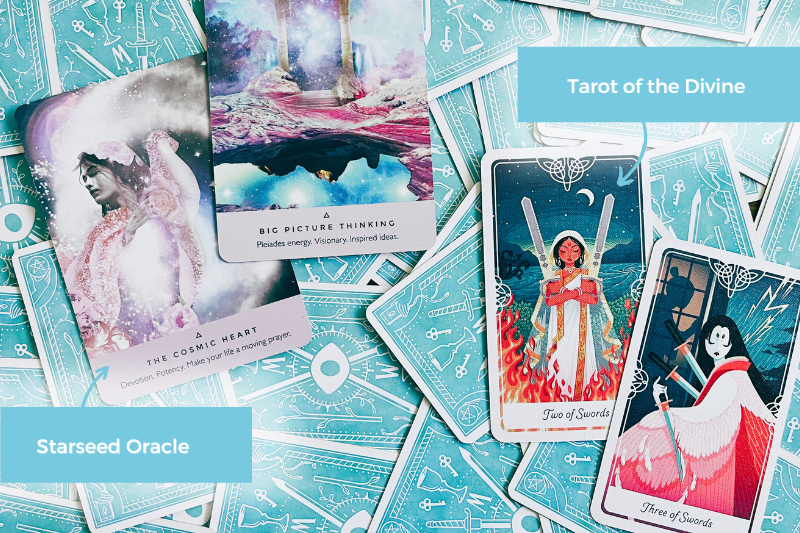
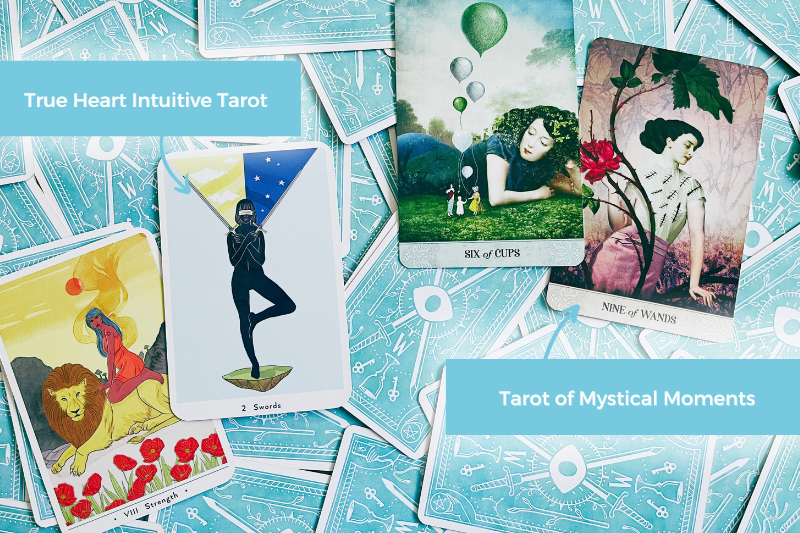
There are so many decks out there and each of them are going to appeal to different people. Even as a professional Tarot reader, there are decks that I don’t resonate with and have a hard time gleaning information from. For example, The Tarot of Mystical Moments and the True Heart Intuitive Tarot are two decks that I really connect with. I look at the images and I instantly know what the card wants to say. On the other hand, the Wild Unknown Tarot is a very popular deck, but I can’t connect with it. The beauty of different decks is they appeal to different people. Find one that speaks to you. 

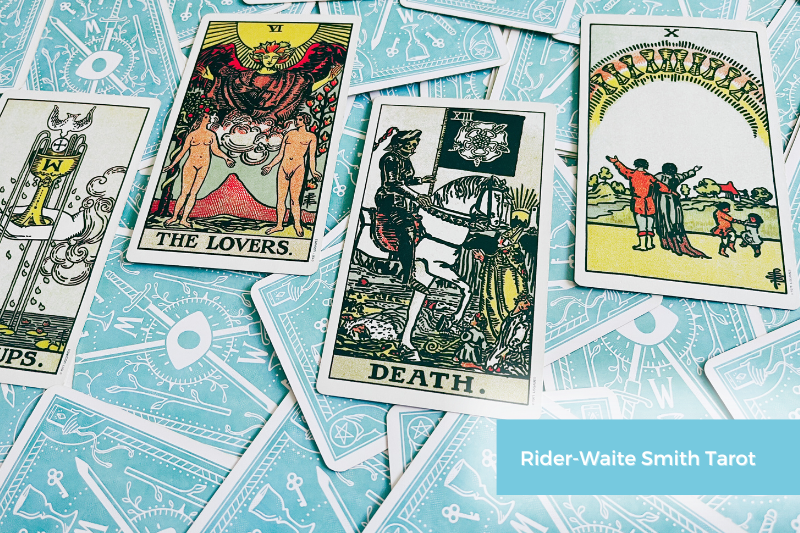
3) When in doubt, use the Rider-Waite Smith Tarot Deck 

A safe bet for tarot learners is the classic Rider-Waite Smith tarot deck. Rider-Waite Smith is the original standard system for what we now call tarot. Published in the early 20th century by the Rider company, commissioned by academic and mystic, A.E. Waite and illustrated by Pamela Colman Smith, the Rider-Waite Smith Tarot deck is the OG.

Because of this, Rider-Waite Smith Tarot is a great deck for beginners because most Tarot books and resources base the descriptions of the imagery and meanings on Rider-Waite Smith’s depictions. Many tarot artists have taken creative liberties on how to illustrate the meanings of the cards, and so even if there is a universal meaning, the imagery may not match up.

I started with the Rider-Waite Smith over a decade ago, which was helpful to me because I was a very analytical person who was not very attuned to symbology. Having books explain to me how an image represented something helped open me up to how symbology works. Because of this, I always recommend Rider-Waite Smith Tarot to learners, especially those who tend to intellectualize over relying on their feelings. 

Modern Rider-Waite Smith Alternatives

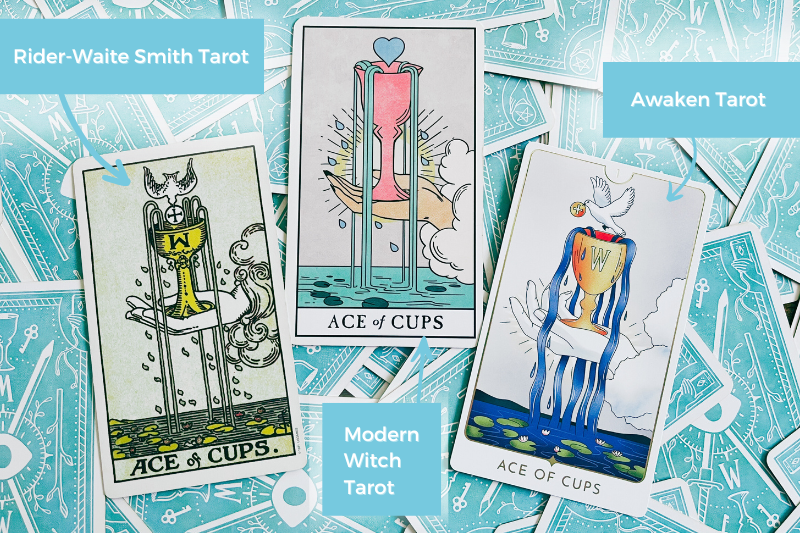
If you’re not a fan of the classic stylings of Rider-Waite Smith, there are some beautiful modernized versions of the Rider Waite Smith Tarot that may be more appealing, such as the Modern Witch Tarot and Awaken Tarot.  The imagery of both of these decks resemble the original, but with a more updated twist. Using these decks, the imagery is close enough for following the explanations in Tarot books and resources, but perhaps more aesthetically appealing for our contemporary senses.

A note about Rider-Waite Tarot vs Rider-Waite Smith Tarot

When you go to buy this classic deck, you may notice it’s called Rider-Waite Tarot. Both of these decks are the same exact decks. As a feminist in the tarot community, we try to call this classic deck Rider Waite Smith Tarot to include illustrator, Pamela Colman Smith included as she was left out of the credits in the original deck, even though it is her illustration that has been such a huge impact and influence on what Tarot is today, she didn’t get the credit she deserved. In honor of Pamela Colman Smith, I refer to the deck with her name included.

4) Don’t over analyze it, go with your intuition

And lastly, there’s no need to over-analyze! Use your gut when choosing a deck. Maybe you’re at the crystal shop and you’re feeling good vibes from a deck — trust your intuition! You can’t really go wrong. Just as Lao Tzu says “When the student is ready, the teacher will appear”, the same can be said about tarot. If you feel an urge to start learning Tarot, get your first deck and start pulling cards.

2023-08-11T19:12:01+00:00Tags: , |

The Beauty of Meaninglessness: Some Thoughts after a Miscarriage

The Beauty of Meaninglessness: Some Thoughts after a Miscarriage

Dated: July 8, 2023

Last week, I had a miscarriage, I was 7 weeks and two days pregnant. My husband and I had been trying to conceive for 18 months and we had undergone two failed rounds of IVF, when we surprisingly became pregnant naturally, two months after our wedding celebration.

It was a miracle — and then — it was heartbreaking.

What followed was a short, but intense dark night of the soul moment for two solid hours as I laid in bed crying into my pillow.

What the point of it all? I wondered. I should just give up all I am pursuing. 

The despair gave way to thoughts of an ever-present core issue for me: my need to know.

“I don’t know anything,” repeated in my mind.  I had adopted the “I don’t know” mantra after our 2nd failed IVF attempt, but I had forgotten about it.

I forgot that I don’t know anything.

After the positive pregnancy test, I thought that maybe I do know some things. That I figured some stuff out around the inner workings of the Universe. (As if we could ever know for sure!)

But now, here I am again, back to “I don’t know.”

“I don’t know” is humbling. Couple this with grief and what you have is an emptiness, a void. A letting go of everything one has ever learned about anything. A releasing of programmed thoughts, beliefs, learnings.

It’s disorienting, but it’s a gift. In that moment, I didn’t want to see it as a gift.

My naturally analytical mind wants to intellectualize and find meaning in it all. I want to know. I want to know why. What did I do, or not do, to cause this?

In a session with my mentor, I inquire about a spiritual reason. She asks me, what if there is no reason?

I thought about it and felt into my body.

If there was no reason, I would feel relieved — that’s what my body said.

If there is no meaning, there is no one to blame — including me.

If there is no meaning, then there is nothing for me to do, or not do.

If there is no meaning, then there is no right or wrong.

If there is no meaning, it allows me to let go.

I tell her this and we do some healing on shame of my body, and my need to intellectualize a reason. I feel a resonance in my heart when I let go of meaning.

I feel relieved.

“It’s the Mystery of Life”, she says. “How it happens. Despite all the biological and scientific advances, no one truly knows.”

She is right. It is a mystery, and it is beautiful.

As humans with minds, we’re uncomfortable with the mystery; we fear meaninglessness.

We search for it. Or to speak for myself, *I* search for it.

I want to ‘figure it out’ so that I can prove my intelligence. Feel like I understand the Universe. Have control over the uncontrollable.

It’s humbling to once again be reminded that I do not.

Meaninglessness has its perks. When things are meaningless, there’s no negativity or positivity. It’s neutral. Which doesn’t sound fun, but when one goes on an emotional rollercoaster, up and down, and around, neutral is nice. The highs and lows have made me feel alive, and I appreciate it in a strange way. I feel gratitude for feeling something, after shutting emotions down for decades of my life. But after a while, I need a bit of good old, boring neutral.

Neutral is nice.

Neutral is peace.

—

I don’t intend to stay in meaninglessness forever. I absolutely love deriving meaning. I adore it. Deriving meaning is one way I see and experience grace.

But meaninglessness and neutrality is also grace. Both can be true.

For now, I hold these opposites — this dichotomy — without judgement.

At the end of my life, perhaps I will look back and see it. After everything that happens, I can be the bird flying high that can see the overview, and get the meaning of it all.

But right now, in the middle of it, meaninglessness is medicine.

And I will swallow its bitter-sweetness in grace.

⁠
In gratitude, Bonnie
???✨

2023-07-12T19:35:13+00:00
Go to Top